
How Dental Implants Protect Against Bone Loss: A Mckinney City Dentist Explains
Because dental implants replace a missing tooth’s root as well as its crown, they prevent bone loss. Through a process known as osseointegration, the titanium implant post merges directly with your jaw bone, stimulating the bone each time you chew. The body resorbs the surrounding bone in the absence of a root or implant in the socket, and published research indicates that around half of the bone width may be lost during the first year Currently, the only tooth replacement that prevents this process at its root is an implant.
I’m Dr. Sheikh, the head dentist at Mckinney City’s ProCare Dental Studio. At our Coid Street location, I restore bone and place implants every week. One of the most frequent things that patients are shocked to learn about is bone loss. Concerned about the appearance of a missing tooth, people come in. The larger problem is typically what’s going on underneath, which a 3D x-ray will reveal in detail but is invisible to a standard mirror.
What happens to your jaw bone when you lose a tooth
You have a living jawbone. It is not a static structure. It constantly changes according to the weight it bears, just like the rest of your skeleton. Chewing forces are sent into the bone through the roots of your teeth, and this pressure signal instructs the bone to remain thick and in its current location.
That signal ceases when a tooth is pulled. Almost instantly, the bone in that region begins to shrink.
Schropp and associates conducted a seminal clinical study in 2003 that tracked patients for a full year following a single tooth extraction. They discovered that within the first year, the ridge of bone where the tooth had rested lost around half of its width, with the majority of the loss occurring in the first three months (Schropp L, Wenzel A, Kostopoulos L, Karring T. Int J Periodontics Restorative Dent 2003;23(4):313-323). Tan and colleagues’ 2012 systematic review (Tan WL, Wong TL, Wong MC, Lang NP. Clin Oral Implants Res 2012;23 Suppl 5:1-21) verified comparable dimensions changes throughout the published literature.
Why this matters beyond the missing tooth
Bone loss is more than a study’s numerical value. I witness actual patients in my clinic dealing with the fallout:
- The bite is thrown off when nearby teeth move into the vacant space.
- The absence of the bone supporting the lip and cheek causes the face to seem depressed in that region.
- Year after year, the ridge that dentures rest on continues to diminish, causing them to stop fitting.
- Because there is less bone to anchor into, future implant placement becomes more difficult.
- The surviving teeth must withstand greater chewing force than they were intended to, which speeds up wear and fractures.
How a dental implant stops the process
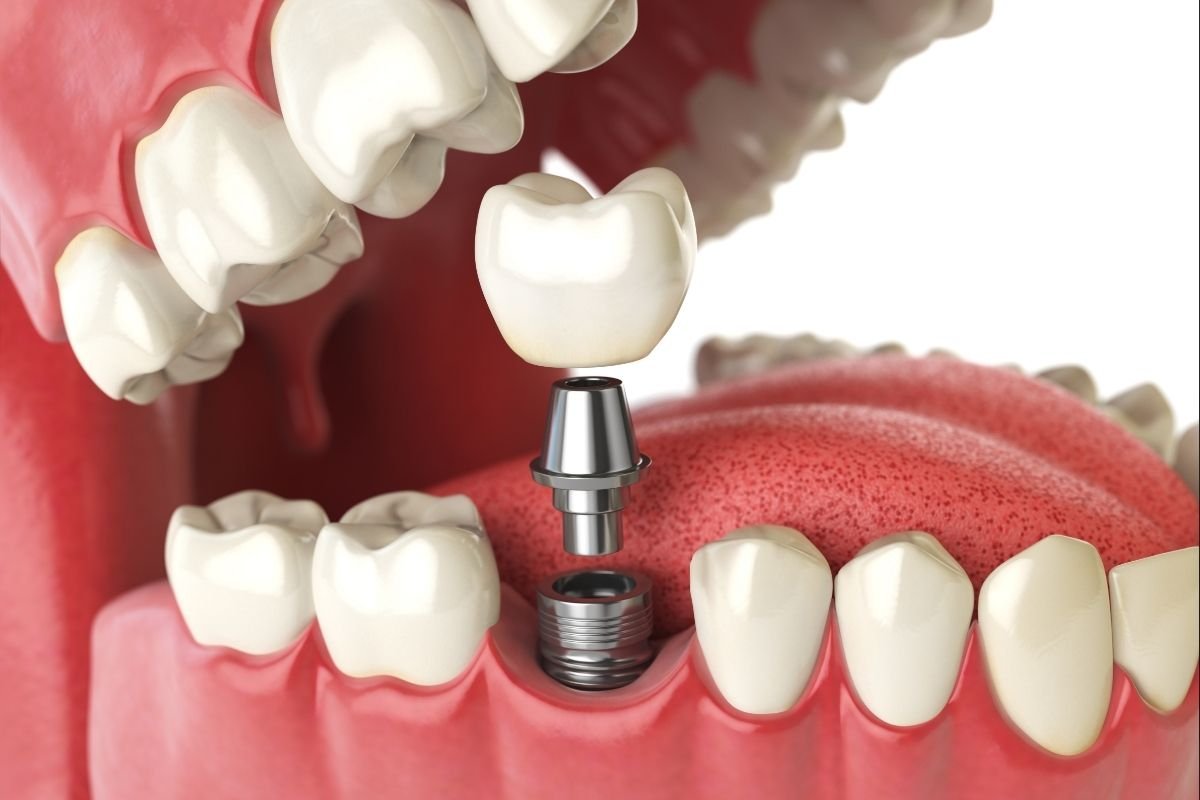
A dental implant is a tiny titanium post that is inserted into your jawbone to replace a lost tooth root. Bone cells proliferate onto and into the implant’s surface during the ensuing weeks. Osteointegration is the term for this biological connection, which explains how implants function.
The implant performs the same function as the tooth root once it has merged. Each time you chew, force passes through the implant, the crown, and the surrounding bone. The bone remains thick and receives the necessary load signal.
Excellent results have been reported for implants placed according to sound technique. According to Lang and colleagues’ 2012 systematic review, when patient selection and protocol are done correctly, the survival rate for implants placed into new extraction sockets is roughly 98.4% at one year (Lang NP, Pun L, Lau KY, Li KY, Wong MC. Clin Oral Implants Res 2012;23 Suppl 5:39-66). After the first year of loading, little annual bone loss surrounding the implant is the clinical benchmark that we still use today to determine whether the bone is being kept over the long term.
Why a bridge or a denture doesn’t do the same thing
Because bridges and dentures are typically less expensive up front, patients frequently inquire about them. They don’t treat bone loss, although they are viable solutions in certain situations.
On top of the gum is a bridge. It provides you something to chew on and restores the appearance of the lost tooth, but it doesn’t replace the root. Due to the lack of load, the bone beneath the bridge keeps getting smaller.
Even less protective is a detachable denture. It transmits some stress to the underlying ridge while resting on the gum, but the load is not evenly distributed, and the ridge continues to diminish every year. Because of this, a denture that fits perfectly now frequently feels loose in three or four years. Its supporting bone has shifted. If you’d like a more thorough analysis of these trade-offs, visit our article comparing dentures vs dental implants.
What to expect at a consult for Dental implants
- 3D image of your jaw bone(CBCT scan). Ordinary x-rays only display two dimensions. I can estimate precisely how much bone is left, where the sinuses are located, and where the nerves flow thanks to a CBCT scan, which displays your bone in three dimensions. The majority of patients are taken aback by what is and is not present.
- Pearl AI review of your x-rays. In order to identify areas of bone loss, degradation, and other results that the human eye could overlook, we employ a color-coded artificial intelligence overlay. It provides an additional pair of eyes for your diagnostics.
- Walk-through of the lab side. Our in-house ProCare Dental Lab, located on the same floor as the operatories, is where your crown, custom abutment, or full-arch prosthesis is constructed. The printers, the mill, and the case being constructed for you are all visible.
What you should ask your dentist about bone loss
These are the questions to bring to every implant consultation, whether you come to us or somewhere else:
- “How much bone am I really left with? Can I view my 3D scan?
- “How much bone do you think I’ll lose by the time I wait six months to do this?”
- “Am I eligible for an instant implant on the same day as the extraction?”
- Will a bone graft be necessary for me? If so, what type and why?
- “How will you be able to determine whether the implant is fully integrated before loading it?”
- “What do you do if the implant doesn’t integrate?”